
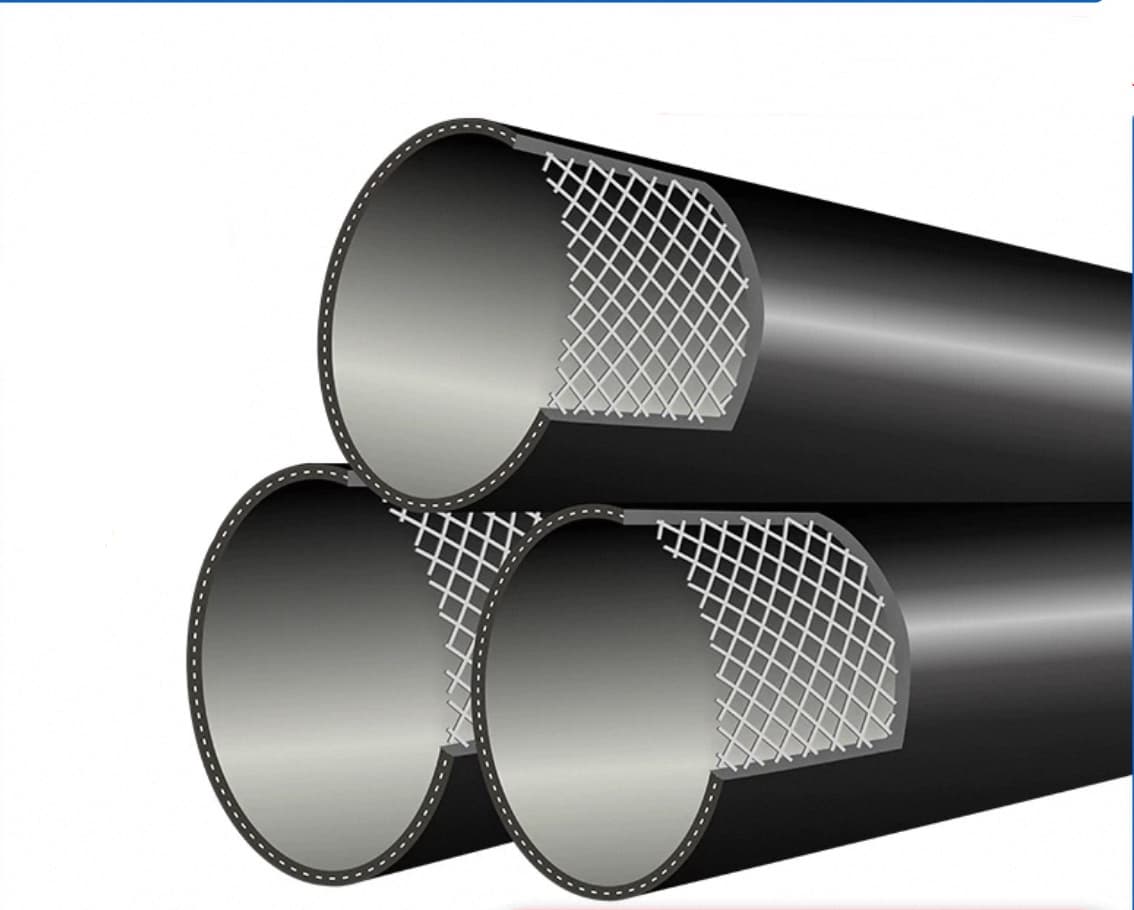
A steel wire mesh is wound into a skeleton and encased in polyethylene, inside and out. The steel carries the hoop load, so the pipe holds pressure classes up to PN35 — well beyond the PN25 ceiling of plain PE100 — while the bore and the outer surface stay polyethylene, with the corrosion resistance and the smooth wall that comes with it.
Because the reinforcement is bonded through the wall rather than laminated on, the layers do not peel. Axial strength is high enough for long buried runs, and joints are made with electrofusion couplers that melt the pipe's outer PE layer into the fitting — the same procedure your crews already use on PE100.
Key features
- Pressure classes PN8 to PN35, above what plain PE100 offers
- DN50 to DN630, produced to GB/T 32439-2015
- Steel skeleton bonded through the wall — no layer separation
- Head loss around 30% lower than steel pipe of the same bore
- Electrofusion jointing, no welding rods or coatings on site
- Corrosion resistant on both faces; 50-year design life
Specifications
| Construction | Welded steel wire mesh skeleton between inner and outer PE layers |
|---|---|
| Diameter range | DN50 – DN630 |
| Pressure rating | PN8, PN10, PN12.5, PN16, PN20, PN25, PN35 (0.8–3.5 MPa) |
| Standard | GB/T 32439-2015 |
| Jointing | Electrofusion couplers and saddles |
| Typical service | Water, slurry, corrosive process fluids |
| Design life | 50 years |