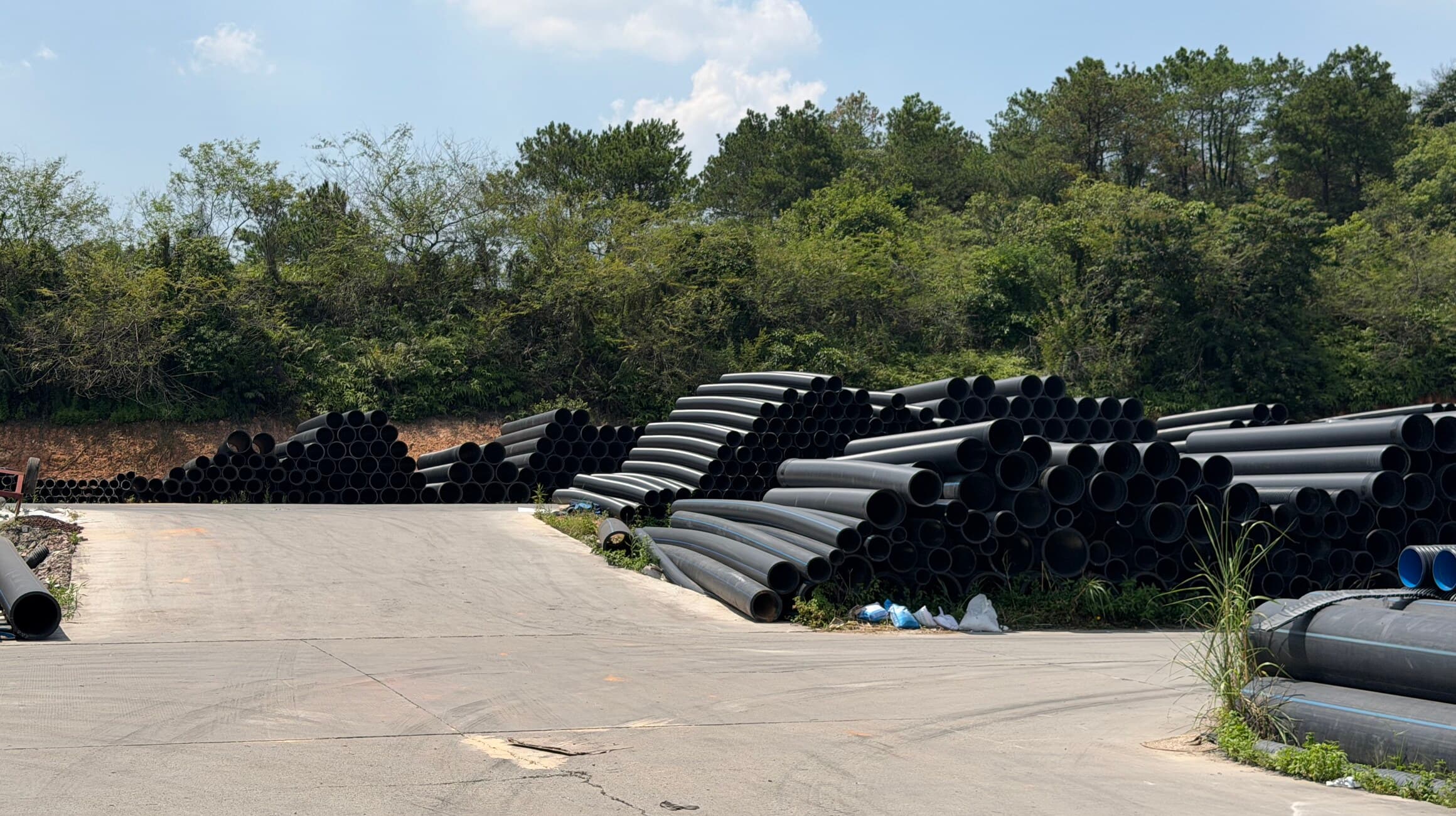
Drainage Pipe
HDPE Drainage & Sewer Pipe
Non-pressure buried pipe, sized by ring stiffness rather than pressure class. We wind, corrugate and extrude structured wall pipe from DN200 to DN2600 in SN4 through SN16, jointed with electrofusion sockets or rubber ring spigots.
Structured wall pipe going into the ground
Drainage pipe is judged on how it behaves once it is buried, which is the part a datasheet cannot show. This is a farmland scheme being laid: trench, bedding, jointing and backfill, at the pace the crew actually works.
The pipe in the ground here is the same double-wall corrugated pipe we extrude to SN4 through SN16 — the ring stiffness class is chosen from the cover depth and the traffic above it.
Ask about ring stiffness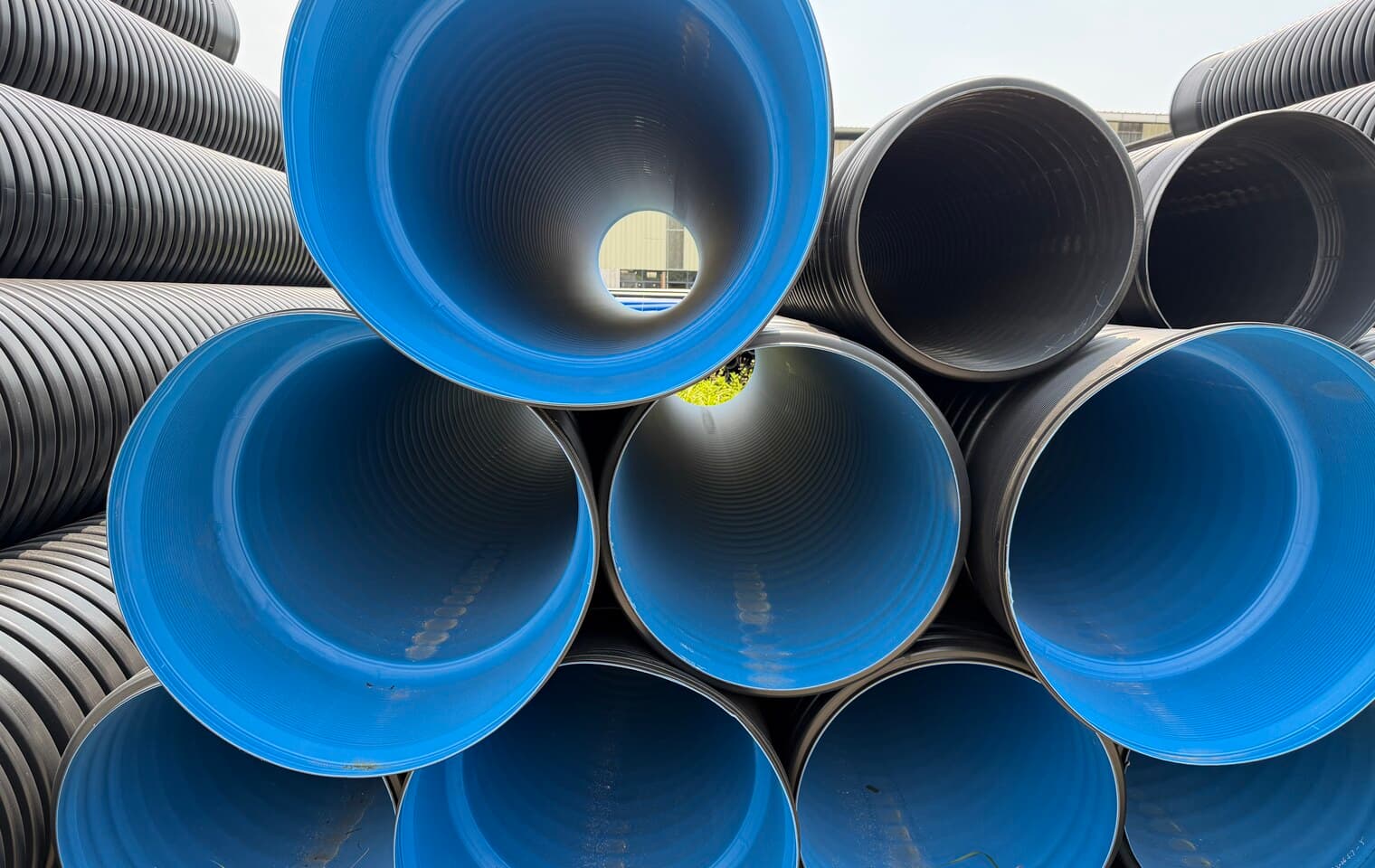
Choosing a structured wall pipe
Buried drainage is not a pressure problem, it is a burial problem. What matters is whether the pipe keeps its shape under the fill and the traffic above it, and that is ring stiffness — SN4, SN8, SN12.5, SN16 — measured in kN/m². Pick the class from the cover depth and the load, not from the diameter.
Above roughly DN800 a solid wall becomes wasteful: you are paying for material that does nothing but hold the shape. Structured wall pipe puts that material where it earns its keep — in corrugations, ribs or a wound profile — and the same stiffness arrives at a fraction of the weight. Which profile suits depends on diameter, on whether the joint has to be watertight, and on how the pipe will be installed.
- Ring stiffness follows cover depth and traffic load, not diameter
- Electrofusion sockets where the joint must not leak; rubber ring for gravity runs
- Steel reinforced profiles carry the largest diameters at lower weight
- Wound structural wall reaches DN2600 and above where corrugated stops
- Standard length 6 m; other lengths produced to order
Frequently asked questions
- SN4, SN8 or SN12.5 — how do I choose?
- By cover depth and what drives over it. SN4 suits shallow runs under landscaping, SN8 is the usual municipal default under roads, SN12.5 and SN16 are for deep cover or heavy axle loads. Getting it wrong is expensive in one direction only: an under-stiff pipe deforms and the line has to come back up.
- Electrofusion socket or rubber ring?
- Rubber ring is faster and cheaper and is fine for gravity sewers where a small amount of infiltration is tolerable. Electrofusion welds the socket to the spigot and gives a joint as tight as the pipe wall — worth it for pressure-tested lines, contaminated ground, or anywhere the line runs below the water table.
Explore the rest of the range
- HDPE PipePE100 pipe DN20–DN1600 for water, mining, drainage and marine service.
- FittingsButt fusion, electrofusion, flange adapters and fabricated specials to DN1600.
- FabricationCustom spools, manholes, tanks and OEM production built to your drawing.
- ApplicationsWhere our pipe goes — water, mining, energy, marine and more.
- ResourcesSpec sheets, SDR tables, fusion procedures, certificates and case studies.
- About UsThe plant, the testing regime and the projects behind the quotation.
Need a quote or a spec check?
Send us your drawing, tender document or bill of quantities. Our engineers reply within 12 working hours with pricing, lead time and a container loading plan.